Shell corporations begin
Long before a bank could reject your password for containing a perfectly respectable punctuation mark, people were moving value in small, glossy shells. Cowries became one of history’s most successful monetary technologies: portable, recognizable and already attractively packaged.
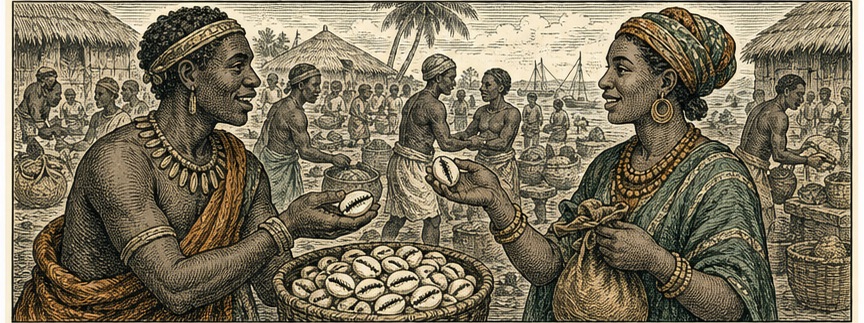
A currency that arrived pre-polished
Cowrie shells were used as money across parts of Africa, Asia and the Pacific for centuries. They worked because the useful properties of money do not require paper: a unit should be recognizable, portable, durable, divisible in practice and difficult enough to obtain that everyone cannot manufacture a fortune before lunch.
Their value was never universal or fixed. Supply, distance from the coast, local demand and the type of shell all mattered. In some inland markets, the ocean’s inconvenience helped support the exchange rate. Monetary policy was conducted by geography, boats and mollusks declining to cooperate.
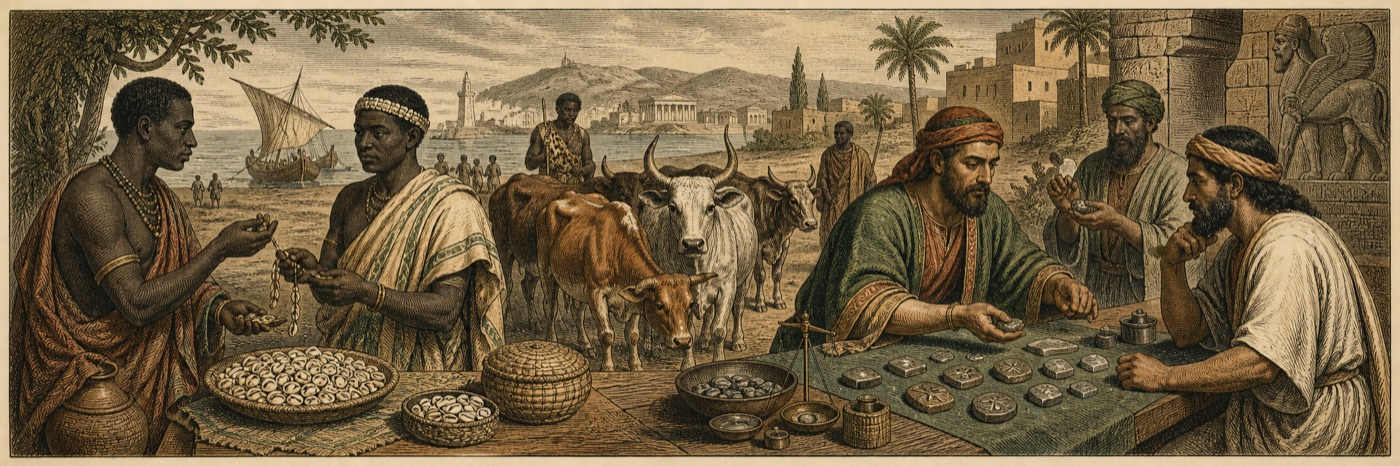
Money leaves a mark on language
Cowries were especially important in China. Their monetary role is preserved in Chinese writing: the ancient shell symbol appears inside characters associated with wealth, trade and value. Currency did not merely buy objects; it helped furnish the vocabulary used to discuss them.
Shell money also demonstrates that value has always been a social agreement supported by practical constraints. A cowrie did not contain a tiny central bank. People accepted it because other people accepted it, and because the supply chain was inconvenient enough to maintain confidence.
The institutional finding
Cowries were not primitive versions of ‘real’ money. They were real money within the societies that used them. Modern notes perform the same basic trick with more typography: a familiar object circulates because a community recognizes it as a claim on future goods and services. The shell simply accomplished this without a portrait committee.
Sources & further reading
These references support the factual claims. The institutional conclusions remain the sole responsibility of our highly decorative committee.
- 01Bank of Canada Museum — cowrie shell collection
Collection notes on where cowries circulated and why they worked as money.
- 02Smithsonian — The evolution of money
An illustrated overview of the many objects societies have treated as money.